
India’s welfare architecture has undergone a profound transformation over the last decade. What was once characterised by fragmented subsidies, leakages, and intermediary-driven delivery has evolved into one of the world’s largest digitally enabled welfare ecosystems.
The convergence of the Jan Dhan–Aadhaar–Mobile (JAM) trinity, coupled with the expansion of Direct Benefit Transfer (DBT) systems after 2015–16, fundamentally changed the mechanics of welfare delivery and made targeted welfare both administratively feasible and politically attractive.
Subsidies and cash transfers that earlier suffered from duplication, ghost beneficiaries, and administrative inefficiencies could now be transferred directly into verified bank accounts with unprecedented scale and precision. Over time, the JAM-DBT ecosystem has converted rights-based entitlements from policy promises into operationally reliable delivery mechanisms.
Current welfare delivery paradigm across states
In the years following the COVID-19 pandemic, however, welfare politics entered a new phase. Rising cost of living pressures, economic disruptions caused by the pandemic, and heightened political competition led to a rapid expansion in the scope and scale of welfare schemes across states, culminating in the current state of ‘competitive welfarism’.
States increasingly introduced or expanded schemes such as free electricity, free public transport for women, cash transfers to specific demographic groups, expanded public health insurance, and various forms of direct income support. Consequently, the cumulative welfare footprint on households — and on state finances — has steadily expanded. A bouquet of such schemes has emerged and political parties across the spectrum are choosing schemes for implementation from this list basis their political need.
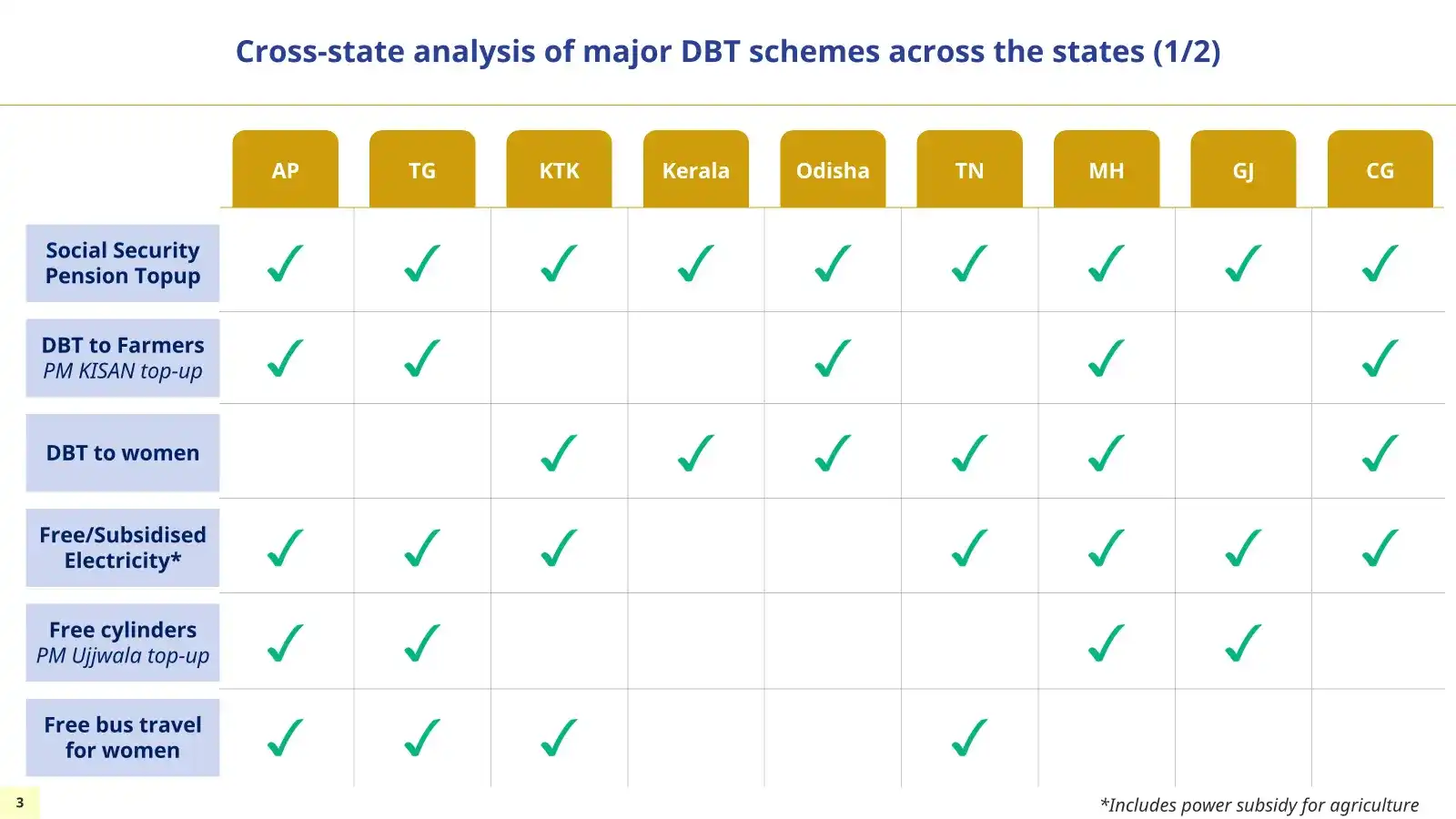
Source: Samagra Analysis
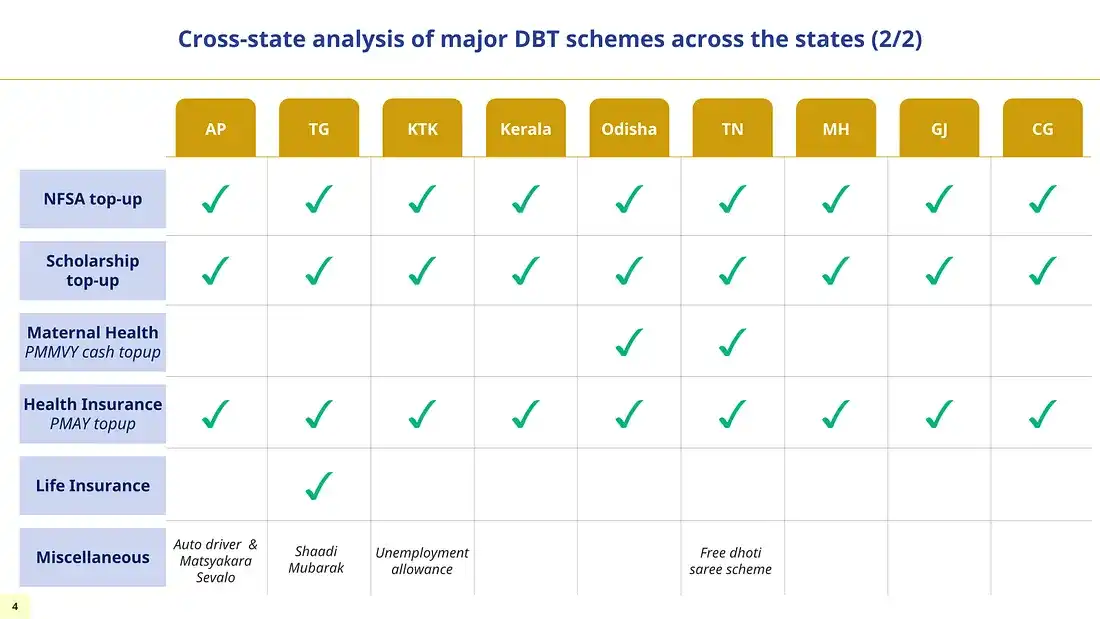
Source: Samagra Analysis
Role of elections in propagating ‘competitive welfarism’
Over successive election cycles, welfare competition has increasingly followed three broad dimensions.
- Enhancement in quantum of benefits within existing schemes — For instance, the newly elected government in Tamil Nadu recently increased the free electricity entitlement for households from 100 units to 200 units per month.
- Expansion in coverage of beneficiaries — A prominent example is the gradual movement by several states toward universal or near-universal cashless health coverage in private hospitals, going well beyond the approximately 50 crore beneficiaries covered under Ayushman Bharat.
- Introduce new welfare schemes from a standard bouquet of schemes — For example, the new government in Kerala has introduced a free bus scheme for women, which it promised in its manifesto.
This dynamic has created a predictable pattern in state politics. Welfare announcements increasingly dominate state politics. Either such schemes are rolled out by incumbents in the run-up to elections, or they are part of electoral manifestos.
Newly elected governments often prioritize a rapid rollout immediately after assuming office to signal administrative responsiveness and political commitment. In contrast to structural governance reforms — which require institutional capacity, long-term planning, bureaucratic coordination, and sustained political capital — the rollout of welfare schemes is administratively much simpler and politically more visible.
Challenges emerging from ‘competitive welfarism’
The expansion of welfare provisioning has led to a situation where per capita welfare expenditure across states is rising at an unprecedented pace. Internal analytical work undertaken by Samagra indicates the quantum of benefit delivery expenditure across states in terms of per capita expenditure and as a share of non-committed expenditure (budget expenditure after accounting for committed expenditure of salaries, pensions and debt repayment).
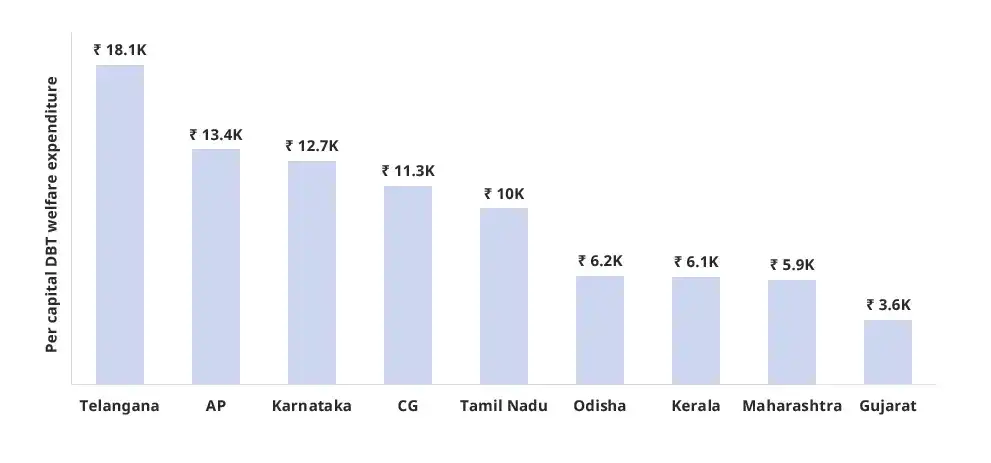
Source: Samagra Analysis
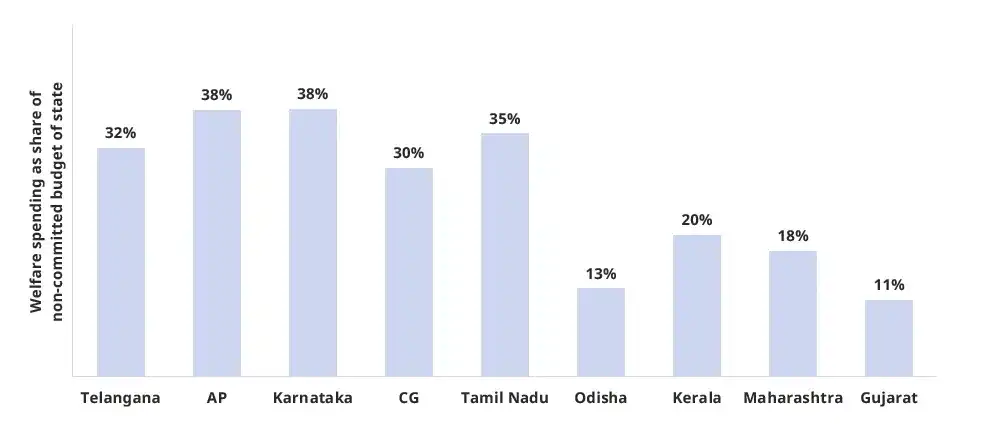
Source: Samagra Analysis
The 16th Finance Commission in its report has also highlighted the unprecedented pace at which expenditure on subsidies and transfers has risen across almost all states in the country.
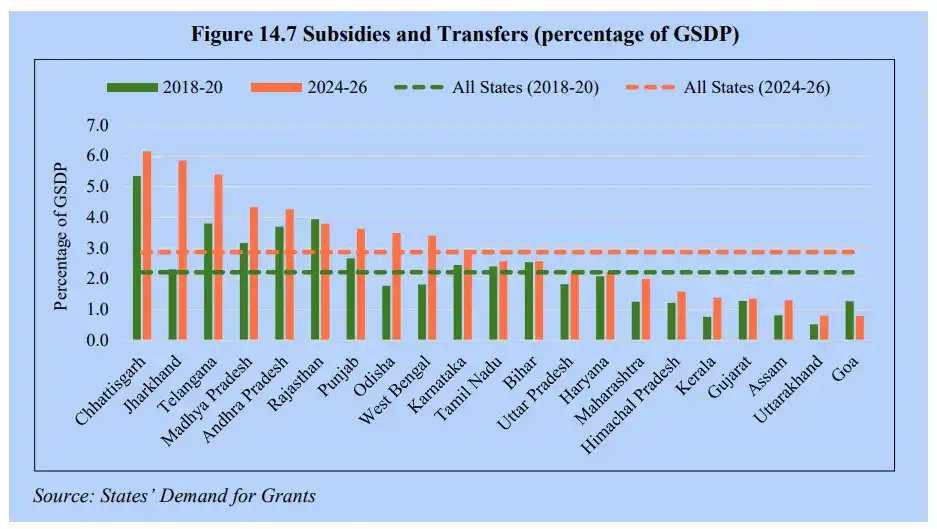
Source: Report of the 16th Finance Commission
This, in turn, has significant fiscal implications, particularly because several states are already operating beyond the fiscal discipline thresholds envisaged under the Fiscal Responsibility and Budget Management Act, 2003 (FRBM Act).
In many cases, welfare expenditure is increasingly consuming a substantial share of the discretionary fiscal space available to states after accounting for committed expenditures. As a result, fiscal flexibility for long-term developmental investments is gradually shrinking.
The opportunity cost of this trajectory is high. Rising revenue expenditure on recurring subsidies often crowds out expenditure on capital formation, infrastructure creation, and long-term productive assets.
To illustrate the scale involved, Karnataka’s annual subsidy and transfer expenditure is estimated at nearly ₹85,000 crore. 1% of this amount would be sufficient to operate a full-fledged IIT–scale institution every year. Similarly, the annual budget of the Department of Science and Technology in the Government of India for FY 2026–27 is one-third of the subsidy burden incurred by Karnataka this year.
‘Side effects’ of benefit transfer schemes
Beyond their immediate fiscal implications, large-scale subsidies and welfare schemes also create important second-order and third-order effects on the broader economy and governance ecosystem.
Most subsidies are, in essence, policy instruments designed to provide immediate relief for an underlying social or economic challenge that governments may not be able to solve structurally in the short term because of administrative, fiscal, or institutional capacity constraints. In that sense, subsidies often function as temporary “band-aid” interventions intended to buy time while deeper reforms are undertaken.
The challenge arises when these temporary interventions become permanent political commitments without corresponding structural correction. Over time, the subsidy itself begins reshaping citizen behaviour, market incentives, public expectations, and institutional priorities in ways that may unintentionally deepen the original problem.
The evolution of health insurance schemes in India illustrates this dynamic. Governments sought to reduce catastrophic out-of-pocket healthcare expenditure for poor households, particularly because building high-quality public healthcare infrastructure at scale required substantial time, investment, and administrative capacity. As a result, schemes such as Rashtriya Swasthya Bima Yojana, followed by Ayushman Bharat and various state-level top-up programs, emerged as practical instruments to provide immediate financial protection for hospitalization and tertiary care.
These schemes undoubtedly achieved important objectives by improving access to healthcare and reducing the direct financial burden on vulnerable households. However, insurance-based access was always intended to complement — not substitute — investment in public healthcare systems. Parallel strengthening of government primary health centres, secondary hospitals, medical personnel, diagnostics, and preventive healthcare infrastructure remained essential.
If this parallel strengthening does not occur at a sufficient pace, a gradual structural shift can emerge where increasing numbers of citizens become dependent on private healthcare ecosystems backed by publicly financed insurance reimbursements. As middle-class and lower-income populations progressively migrate toward private facilities due to perceived quality differences, public healthcare institutions may face declining political attention, weaker accountability, talent shortages, and deteriorating service quality. Governments may then find themselves trapped in a difficult equilibrium: unable to withdraw insurance support because of public dependence, while simultaneously needing to continue financing underutilized public health systems to avoid accusations of weakening welfare support. What began as a transitional welfare mechanism thus risks becoming a permanently escalating fiscal obligation.
A similar phenomenon can be observed in the power sector. Free or heavily subsidized electricity was originally intended to support vulnerable households and improve agricultural viability. However, over time, prolonged under-pricing of electricity has contributed to severe financial stress among power distribution companies (DISCOMs), distorted consumption incentives, delayed investment in distribution infrastructure, and weakened payment discipline across the energy ecosystem. The cumulative financial stress on DISCOMs has had cascading consequences for state finances, banking systems, energy investment, and ultimately broader economic efficiency.
Likewise, free public transport schemes for specific demographic groups may generate important short-term social outcomes such as improved mobility, enhanced workforce participation, and reduced household expenditure burdens. Yet such interventions can also produce secondary economic effects on informal transport ecosystems. Declining ridership for auto-rickshaw drivers and other small transport operators may reduce incomes within those sectors, eventually creating fresh demands for compensatory welfare measures for newly affected groups. In this manner, one welfare intervention can indirectly create conditions necessitating additional welfare interventions elsewhere in the economy.
This illustrates a broader policy challenge: welfare interventions do not operate in isolation. They alter incentives, redistribute economic activity, and influence labour and consumption behaviour. If governments focus only on the immediate first-order benefits of subsidies without continuously addressing the underlying structural bottlenecks, welfare systems can gradually transition from corrective instruments into self-reinforcing fiscal ecosystems.
Therefore, the long-term sustainability of welfare policy depends not only on the fiscal affordability of individual schemes, but also on whether those schemes are accompanied by credible structural reforms that reduce the need for permanent state support over time. The success of a welfare intervention should ultimately be measured not merely by how many beneficiaries it serves today, but by whether it reduces future dependency through stronger public systems, higher productivity, better human capital, and improved economic opportunity.
The argument, however, is not for the elimination of welfare support. In a country where a large population still depends on state assistance for basic sustenance, welfare remains an essential instrument of social stability and equity. The challenge is therefore not whether welfare should exist, but how welfare should evolve in a fiscally sustainable and development-oriented manner.
Way Forward
A broad political and policy consensus may therefore be necessary around certain principles for the next generation of welfare design.
- Limit universal welfare schemes to foundational public goods such as nutrition, basic food security, and essential healthcare. Even within healthcare, greater emphasis should be placed on strengthening state capacity in primary and secondary healthcare systems rather than relying disproportionately on recurring insurance reimbursements.
- Rely on objective and targeted eligibility frameworks so that benefits reach genuinely vulnerable households rather than becoming generalized consumption subsidies.
- Incorporate clearly defined timelines, measurable outcomes, and sunset frameworks in the design of welfare programs — Interventions designed to address specific socio-economic barriers may be effective in the medium term but need not become permanent entitlements. For instance, free public transport schemes for women may positively influence female labour force participation and mobility, but such interventions should eventually transition toward broader economic empowerment measures.
- Prioritise asset creation over perpetual consumption support via benefit transfer or subsidies — Instead of indefinitely subsidising domestic or agricultural electricity consumption, governments are increasingly incentivising decentralised solar generation systems for households and farms. Such models reduce long-term subsidy burdens while simultaneously creating productive household assets and improving energy sustainability.
- Evolve from welfare being purely protective “safety net” to becoming developmental “trampolines” that enable upward mobility — Karthik Muralidharan, in his book Accelerating India’s Development, distinguishes between welfare approaches that merely sustain consumption and those that actively help individuals transition toward higher productivity and income generation. As India’s middle class expands and economic aspirations deepen, future welfare architecture may need to focus more on employability, skilling, asset ownership, energy transition, digital capability, and human capital formation rather than solely on recurring transfers.
The next phase of welfare policy in India, therefore, cannot simply be about expanding the number or size of schemes. It must be about redesigning welfare itself — from a politically competitive distribution model toward a fiscally sustainable framework that strengthens both human capability and long-term economic productivity.