
1. Delivering Welfare at Unprecedented Scale
Every year, the Government of Uttar Pradesh delivers welfare benefits worth more than ₹58,000 crore through over 180 state and central government schemes. These schemes span pensions, scholarships, food security (PDS), healthcare, and housing — reaching more than 17 crore beneficiaries across the state.
The scale of this effort is immense. Yet despite significant investments in welfare delivery, a fundamental challenge persists: ensuring that the right citizen receives the right benefit.
Welfare data is not absent. Revenue departments maintain caste, income, and domicile records. Agriculture departments hold farmer databases. Labour departments track registered workers. The problem is that this data lives in silos — no single view of a family exists across departments. And from this single root cause, two costly problems emerge.
2. The Twin Challenge: Inclusion and Exclusion Errors
Because departments cannot cross-check records across systems, two structural errors undermine welfare delivery simultaneously:
Exclusion Errors occur when eligible citizens — widows, persons with disabilities, elderly citizens, migrant workers, school-age children — are unaware of schemes they qualify for, lack the required documents, or cannot navigate complex application processes. They never apply, and they never receive support.
Inclusion Errors occur when ineligible beneficiaries remain on rolls — because a beneficiary has died, a household member already receives a similar benefit elsewhere, a family's income now exceeds scheme thresholds, or a farmer's landholdings exceed eligibility limits. Without cross-department data, departments cannot detect these cases. The result: eligible citizens are left out while public resources leak to those who no longer qualify.
Recognising this challenge, the Government of Uttar Pradesh embarked on an ambitious mission in 2022: to build a trusted family-level database that could address both errors at once. This program is known as Family ID.
3. Building the Family ID Database
At the heart of the initiative lies a simple concept: every family in Uttar Pradesh receives a unique 12-digit Family ID. Each ID links individual family members and enables the government to understand relationships, eligibility conditions, and benefit delivery at the family level — not just the individual level.
Family ID consolidates information from multiple government databases into a unified family record across three categories:
- Identity Data: Name, age, gender, address, domicile status, mobile number, and family relationships.
- Eligibility Data: Caste, income, disability status, educational qualifications, occupation, marital status, and landholding information.
- Transaction Data: Benefits received through various welfare schemes.
Rather than relying on self-declared information, Family ID sources key eligibility attributes from pre-existing government databases — income from income certificates, caste from caste certificates, landholding and occupational data from the departments responsible for maintaining them. Aadhaar serves as the linking mechanism, enabling databases to communicate while preserving departmental ownership of data.
The Public Distribution System (PDS) database, covering more than 14 crore citizens through Aadhaar-authenticated family records, became the foundation. Additional families were onboarded through a self-registration process.
Building Family ID required extensive coordination across departments. Each department digitised records, seeded Aadhaar numbers, implemented authentication, and integrated with Family ID through APIs. Today, data from 95 schemes has been integrated — including both Government of India and Government of Uttar Pradesh schemes.
4. Solving the Exclusion Error: Reaching the Unreached
Historically, welfare delivery has been reactive. Citizens were responsible for discovering schemes, gathering documents, and submitting applications. At every stage, eligible citizens could fall through the cracks, and many did.
Family ID reverses this model. Using the unified database, departments can now identify citizens who appear eligible for schemes but are not currently receiving benefits. Potential beneficiaries are identified using predefined eligibility criteria, their details shared with departments and district administrations, and verification conducted on the ground — after which eligible citizens are proactively enrolled.
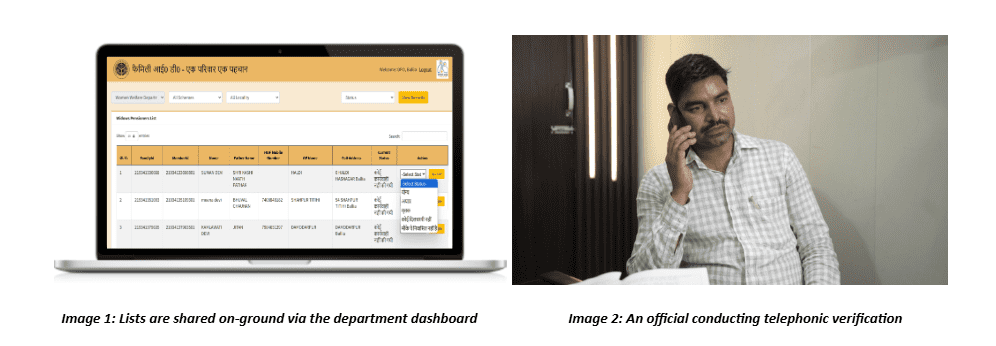
This approach has driven large-scale inclusion across multiple welfare schemes. Beneficiaries identified include widows, persons with disabilities, elderly citizens, migrant workers, and school-age children who had previously remained entirely outside welfare systems, not because they were ineligible, but because the reactive model never reached them. Over 43 lakh eligible citizens have been enrolled across food security, pensions, health insurance, and social protection schemes.
Financial impact: approximately ₹700 crore worth of welfare benefits now reach eligible citizens who were previously excluded from government support.
5. Solving the Inclusion Error: Protecting Public Resources
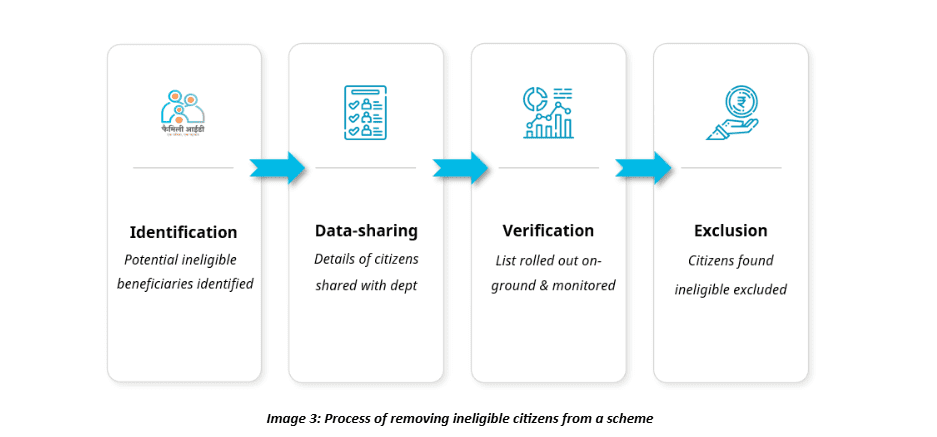
Effective welfare delivery is not only about including the deserving, it also requires protecting public resources from leakage. Family ID enables departments to identify potentially ineligible beneficiaries using objective criteria sourced from trusted, cross-department databases.
Common inclusion errors addressed include:
- Deceased beneficiaries continuing to appear in active lists
- Multiple beneficiaries of the same family receiving benefits under the same scheme
- Households with income-tax paying members enrolled in poverty-linked schemes
- Applicants whose family landholdings exceed scheme thresholds
Critically, exclusions are not automatic. Potential cases are identified and shared with departments for field verification. Only after due verification are beneficiaries removed — preserving fairness and due process. More than 32 lakh potentially ineligible beneficiaries have been identified and removed across food security, social security pensions, and other schemes.
Financial impact: approximately ₹1,100 crore in annual budgetary leakage prevented — resources now redirected toward citizens who genuinely need support.
6. The Impact: ₹1,800 Crore Realigned
Uttar Pradesh set out to solve a problem of misalignment — public resources not reaching the citizens who needed them most, while leaking to those who did not qualify. Family ID, by addressing both the exclusion error and the inclusion error simultaneously, has begun to fundamentally change this dynamic.
This is not merely a technology story. It is a story about what becomes possible when government data, collected by dozens of departments over decades, is finally made to work together. Family ID demonstrates that the data to solve welfare misalignment already exists. What was missing was the infrastructure to connect it. As Family ID continues to evolve, with more schemes integrated, more departments contributing data and conducting proactive verification, its potential extends further still: towards a model where eligible citizens no longer need to find the government. The government finds them.